
BANG! The sound hit like a bulldozer crashing into a building. Then another. After a few frozen moments, I realized that someone was trying to break down my office door.
“Hey! SOMEONE’S HERE!” I screamed, my heart pounding.
The would-be intruder fled, but the message was clear: my seedy office space, while cheap, wasn’t cutting it.
Over the last 15 years I have worked almost everywhere. Offices in the city center with a crushing commute. Half a dozen co-working spaces ranging from decent to cringe-worthy. For six weeks from a VW Vanagon, which is ideal in a pinch (and looks killer on Instagram), but not ideal long-term.
Some settings were decent, some were terrible – but none were perfect.

Fast forward two years.
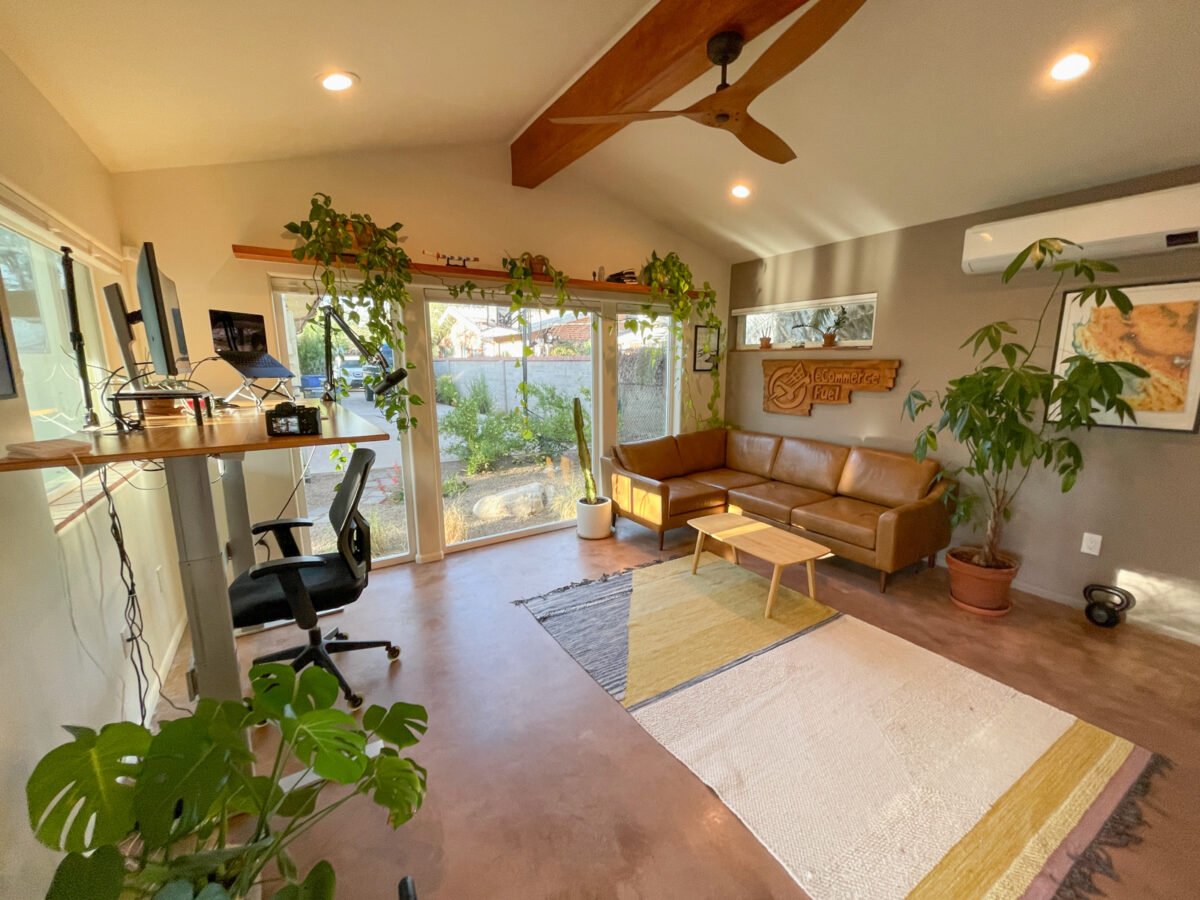
Today I walk 20 seconds from my house to my custom built backyard office. The windows frame the mountains and the panorama. The rain chain flows into a desert garden where hummingbirds visit flowering native plants. The space is flooded with natural light and my kids sometimes wave as they play outside.
It took two years and $175,000 to build the 40×40 vacant lot on our property. And it was one of the best decisions I ever made.
Inside my Dream Build
After years of compromises on workspaces, I became obsessed with every detail of this build. The main room—about two-thirds of the total 380 square feet—is my work sanctuary. Three large windows flood the room with natural light while preventing direct glare. High ceilings make the space twice as large, while carefully placed handmade Mexican tiles add character.
My table overlooks the mountains and a small garden courtyard, but the real magic happens in the bar. It’s a small two-person counter that juts out into the patio space, surrounded by windows on three sides. It has become a favorite place for coffee breaks, calls or when I just need to mix up the workplace.

The rest of the space is divided between a compact kitchen and a bathroom. No full range (that would cause zoning issues), but the kitchen has everything else: sink, dishwasher, microwave and floating bamboo shelves to match the bar top. The bathroom has a waterfall shower – perhaps too big for an office – but will secure the space as a potential guest house or rental in the future.
I spent months considering the layout and thought of dozens of ideas. Every square foot serves a purpose (or three). The Murphy bed doubles as a bookshelf. The bar area functions as a dining table for two. Even the porch was designed with work and energy efficiency in mind, with a cover that blocks the harsh afternoon (and hot) sun while preserving the view.
A day in a (new) life
My morning used to be a circus: a mad scramble to find and pack all my work gear, a hurried goodbye, a 25-minute bike commute, time to set up and get comfortable, finally working until 9am if I was lucky. Lunch meant another 45 minutes to find food. At the end of the day, change the process (and time commitment).
Now? Enjoying a lazy coffee with my wife, actually chatting with my kids over breakfast and walking 20 seconds to my office, arriving earlier than my commute. Lunch is a 30 second walk to our home kitchen – healthier and cheaper than eating out and again with Annie.

When the kids come home from school, they know to look in the windows – if I’m free, they get big hugs and 10 minutes to share their day over snack time. If I’m in a meeting, they wave and run off to play or bounce around the strategically placed boulders designed for children in the Sonoran plant garden planted just outside.
In the winter, I end my day with a sunset, painting the mountain views in gold through the windows. Thirty seconds later, I’m home with my family—no commute, no transition stress.
The separation is perfect: far enough to focus, close enough to be present.
How did the office pay?
The $175,000 price tag is significant and almost kept me from pulling the trigger on the build. But luckily I gave it more thought.
How much will it really cost me? And what is the real benefit?
First, the price tag: the vast majority, probably $150,000, will be added to the home’s value. This isn’t always the case with renovations, but adding new square footage—and especially space that serves a non-discreet purpose—will get you more.
So the actual “cost” is actually more like $25K.
Then there’s the time savings per week without commuting/transportation: 250 hours per year, which I value at $25,000.


Because I designed every aspect of this space, I’m happy there. I’m excited to roll in the morning and smile contentedly as I lock up each night. I’d be shocked if this general shift alone didn’t make me at least 10-15% more productive, so I conservatively add another $20k to my annual work output.
The biggest of all is the general improvement in quality of life. Cool morning, more time with family, easier coordination and transitions.
You can’t put a value on it. But since I’m trying to convince you to build an office, I’ll try. That’s worth at least $25k to me over the course of a year.
To sum it all up:
A one-time cost of $25,000 (costs net of increase in equity)
Annual revenue: $70,000 ($25,000 Commute + $20,000 Productivity + $25,000 Quality of Life)
Yes, financial geeks (like me), there are also opportunity costs, depreciation, etc., etc.
This is not a CPA level analysis. I’m not sure you need one, though: a $25,000 one-time outlay for $70,000 in annual benefits leaves a pretty healthy margin for error. i’m sold
The versatility it provides to your property is also a huge advantage.
I use the space primarily as an office, but could easily convert it into a guest house for visiting friends, a home for elderly parents, a rental for income, or a dedicated mixing studio for my debut EDM album.
Tips for your own construction
Are you ready for your own work oasis?
Don’t rush the design
I spent months studying the construction site at different times of the day. Where is the best view? How does the sun move? Where can children play naturally? This research phase is crucial – and frankly, really fun. The time you invest in planning will pay off exponentially.
Hire and manage builders carefully
For builders, remember the iron triangle: good, fast, cheap – pick two. I chose a good and relatively affordable (read: cheap) one, which meant slower timelines. Get everything in writing and be strategic about the battles you fight.
I let my dreams of a gray water system go when the plumbing made it impossible, but pushed hard when the foundation work dragged on.
Some builders (at least mine) have very specific ideas about how they want to build something. It’s hard for them to let go of their preferences and accept yours. So you have to be firm and push for what you really want, even if it sounds strange to the customer.
Architects optional
Architects can be helpful, but not necessary to achieve amazing results. I worked with my builder to both come up with a design we loved. Then you can hire a draftsman to create plans for you from sketches, which is significantly cheaper than paying an architect $300 an hour for $1,000 designer glasses.

Consider Pre-Fab
Not ready for the headache, time and expense of building from scratch? Prefab backyard offices have come incredibly far with an impressive number of options and are an especially good choice if installation is not critical. A few examples:
Smart friends for your new office
Did you like this post? You will be love discussions that take place within the ECF community. It’s a proven group of 7- and 8-figure owners who talk about advanced business strategies, not salespeople or sales opportunities.
The group cares about building an amazing life alongside a serious business, so you’ll find ideas like this (building a home office) sandwiched between lengthy discussions about marketing channels, tax strategies, and hiring top talent.
Does this sound like your type of people? Join us.